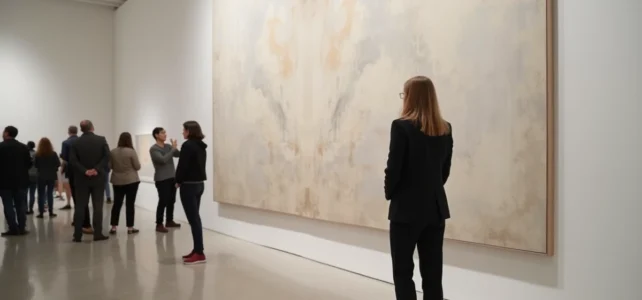
Mag Paris refers to an event dedicated to contemporary art that brings together gallery owners, artists, and collectors around a program designed to intersect disciplines. Unlike a general fair, this type of event structures its offerings through thematic paths, guiding the visit towards discovery rather than just purchase.
Thematic paths and artist selection at Mag Paris
The uniqueness of a fair like Mag Paris lies in how artists are presented. Rather than a lineup of identical booths, the works are grouped by plastic or conceptual affinities. This principle alters the viewing experience: the visitor moves from a sculptural installation to a photographic series because a narrative thread connects them, not because they occupy neighboring spaces.
This method of selection involves curatorial work in advance. The galleries that participate propose pieces based on themes defined several months before the opening. The result resembles more of a collective exhibition than an open market, even though the works remain available for sale.
For emerging artists, being part of a thematic path offers visibility that an isolated booth does not provide. The visitor’s gaze is guided, and the contextualization gives the pieces a resonance they would not have on their own. The partner galleries of Mag Paris play this role of intermediary between the artistic approach and the public.

Contemporary art in Paris: an increasingly dense season
The Parisian contemporary art scene has significantly expanded in recent years. The Grand Palais confirmed in 2026 a program backed by institutional collaborations, with a major exhibition announced until the end of summer. Art Paris occupies the same building every spring. The Cité internationale des arts organizes its Open Studios in May. The galleries in the Marais, Saint-Germain, and Belleville align their openings with these key events.
This densification of the calendar changes the way artists are discovered. Visitors no longer travel for a single event: they build a route over several days, combining fairs, galleries, and institutions. An event like Mag Paris takes advantage of this seasonal logic. Its program fits into an ecosystem where each venue refers to the others.
Major venues and galleries: complementary roles
The institutions (museums, art centers, foundations) serve as entry points. They attract a broad audience, which then discovers the more specialized offerings of galleries and specialized fairs. The Musée d’Art Moderne de Paris, the Centre Pompidou, or the Palais de Tokyo fulfill this function of first contact.
The galleries, on the other hand, delve deeper. At Perrotin, Templon, or Marian Goodman, the visitor accesses long-term work with artists whose careers span several decades. Thematic fairs like Mag Paris occupy an intermediate niche, between institutional visibility and the intimacy of the gallery.
Painting, photography, installation: what Mag Paris showcases
One of the distinctive choices of this fair is not to limit itself to a single medium. Painting coexists with photography, sculpture interacts with digital pieces or spatial installations. This openness reflects the reality of contemporary creation, where artists rarely work in just one technique.
- Contemporary painting remains the most represented medium in the art market, and Mag Paris dedicates a central place to it with varied formats, from small paintings to monumental polyptychs.
- Artist photography, distinct from photojournalism, finds a suitable exhibition space here: framed prints, narrative series, diptychs combining text and image.
- Installations and three-dimensional works allow galleries to showcase pieces that are difficult to exhibit within their own walls due to lack of sufficient space.
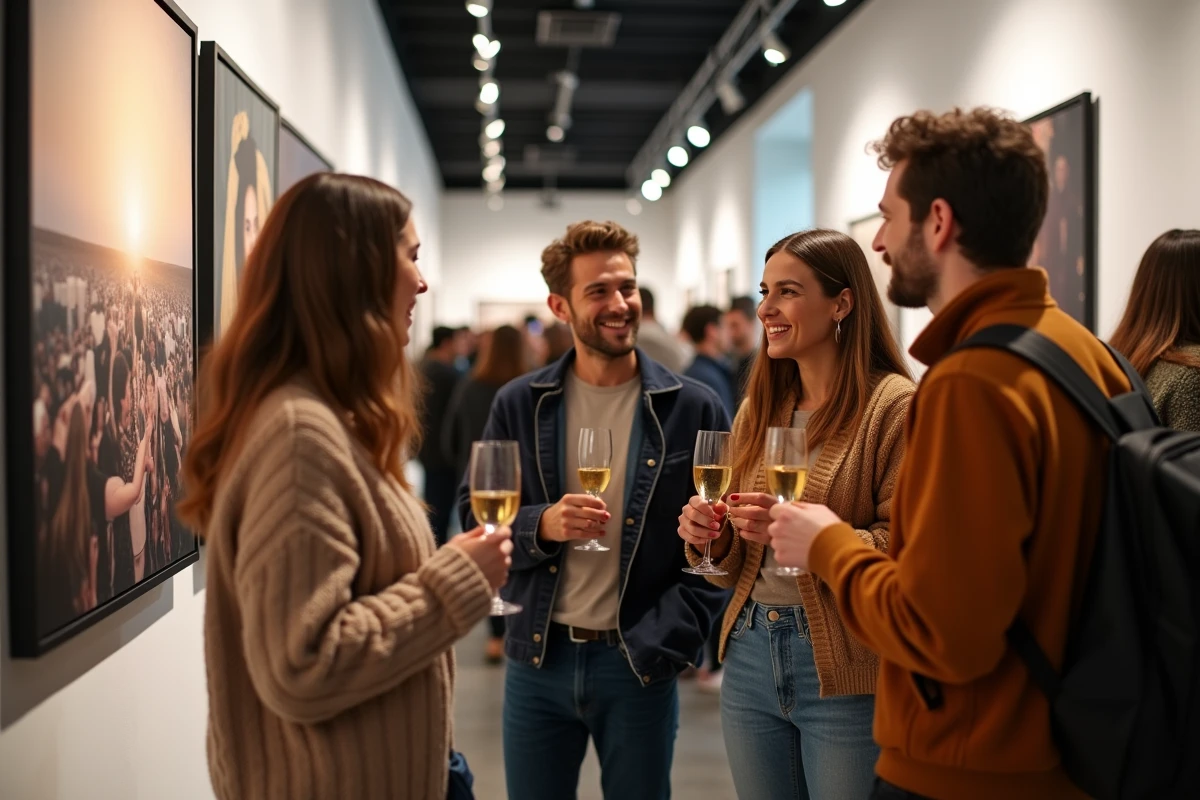
This coexistence of disciplines attracts a diverse audience. A collector coming for the painting discovers photographic work. A sculpture enthusiast stumbles upon an artist’s video. The intersection of mediums provokes encounters that the compartmentalization by gallery does not allow.
Emerging artists and the art market: the role of discovery fairs
The contemporary art market operates on a step-by-step validation system. The artist first exhibits in small spaces or during calls for projects. A gallery spots them, incorporates them into its program. Participation in a fair constitutes the next step: it puts the artist in front of an audience of collectors, critics, and curators.
For an artist at the beginning of their career, the fair represents an accelerator of visibility. But not all fairs play the same role. Major international events favor established galleries and high-profile artists. Mid-sized fairs, like Mag Paris, offer a more accessible platform.
What a collector looks for at a fair
- The coherence of the booth: a well-curated display signals serious gallery work and instills confidence in the artist’s follow-up.
- The artist’s background: previous exhibitions, residencies, publications. These elements are included on the presentation sheets available at each booth.
- The relative price: a collector compares the prices with those of the secondary market and competing galleries to assess the consistency of a valuation.
The fair remains the only format that allows for the physical comparison of dozens of proposals in a few hours. Online platforms have facilitated access to works, but they do not replicate the scale, material, or light of a piece seen up close.
Mag Paris plays this card of direct contact. The fair format, with its aisles, exchanges with gallery owners, and serendipitous discoveries, retains an advantage that the digital realm has not yet caught up with. For contemporary art enthusiasts in Paris, this type of event remains a concrete landmark in an increasingly vast cultural offering.