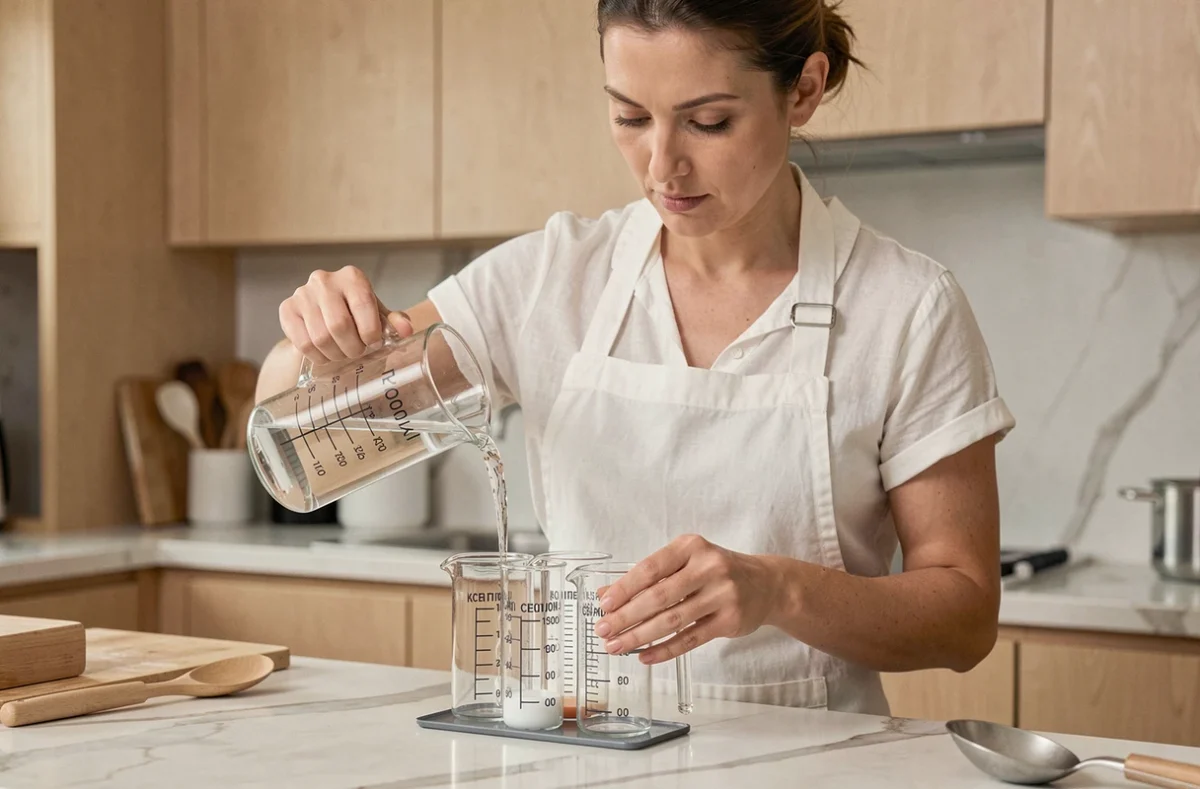
Converting 400 ml to centilitres means dividing by 10, so 400 ml = 40 cl. The calculation takes one step and involves no arithmetic difficulty. The real source of error lies elsewhere: confusing volume with mass. After all, 400 ml of water, 400 ml of milk, and 400 ml of flour take up the same space in a measuring cup, but they do not weigh the same at all when placed on a scale.
Volume and mass: why 400 ml does not always equal 400 g
One millilitre is exactly equivalent to one cubic centimetre. This equivalence, documented in the BIPM’s International System of Units brochure, links a kitchen measurement to a unit of geometry. When we talk about 400 ml, we are describing the space something occupies, not its weight.
For pure water, the correspondence is almost exact: 400 ml weighs about 400 g. This coincidence is what causes the confusion. As soon as you switch ingredients, the relationship breaks down. Milk is slightly denser than water, so the same volume weighs more than 400 g.
Flour, by contrast, is much lighter: 400 ml of flour weighs considerably less than 400 g, and the actual amount varies depending on the type of flour and how the container is filled.
Specialist culinary sources recommend using a scale whenever a recipe gives a weight rather than a volume. In baking, where proportions determine the final texture, this precaution helps prevent significant differences in the result.
When converting 400 ml to centilitres, the volume is always 40 cl, whatever the ingredient. The distinction only matters when converting volume to weight.
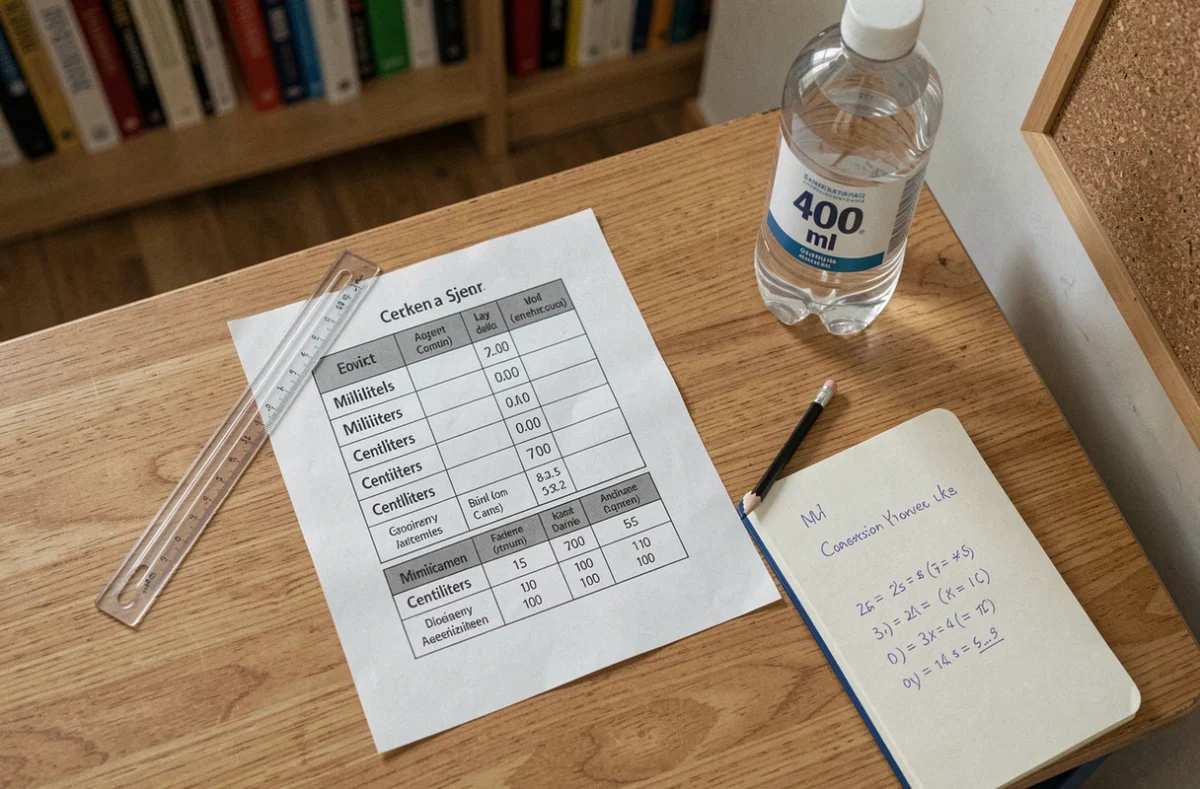
Converting millilitres to centilitres: how to calculate it
The metric system uses standardised prefixes. “Milli” means one thousandth, while “centi” means one hundredth. A centilitre therefore contains ten millilitres. To convert ml to cl, divide by 10. To convert in the other direction, multiply by 10.
For mental arithmetic, dividing by 10 means moving the decimal point one place to the left. For a whole number such as 400, the result is 40.0—or 40 cl. The same principle applies to any value.
| Millilitres (ml) | Centilitres (cl) | Litres (L) |
|---|---|---|
| 50 | 5 | 0,05 |
| 100 | 10 | 0,1 |
| 200 | 20 | 0,2 |
| 250 | 25 | 0,25 |
| 400 | 40 | 0,4 |
| 500 | 50 | 0,5 |
| 750 | 75 | 0,75 |
| 1 000 | 100 | 1 |
400 ml also equals 0.4 litres. This is useful when a recipe gives quantities in litres rather than centilitres.
Measuring 400 ml in the kitchen without a graduated measuring cup
Not every kitchen has a measuring cup with graduations. A few common equivalents can help you make do with the equipment you have.
- A standard mustard glass holds about 20 cl (200 ml). Two full glasses therefore give you 400 ml, or 40 cl.
- A tablespoon holds about 1.5 cl (15 ml). You would need a little over 26 tablespoons to reach 400 ml, making this method impractical for larger volumes.
- A medium-sized bowl often holds between 25 and 35 cl, depending on its shape. One and a half bowls may come close to 40 cl, but the margin of error increases.
For liquids, these estimates are reasonably reliable. For dry ingredients such as flour, a dry-ingredient measuring cup (filled without packing it down, then levelled with the back of a knife) gives a more reliable result than a measuring cup designed for liquids. Flour can only be levelled accurately in a container with straight sides.
When the container makes all the difference
A liquid measuring cup has a spout and markings on the side. Read the measurement at the meniscus (the curve formed where the liquid meets the side of the container). Dry ingredients do not form a meniscus, making side markings less precise. That is why baking professionals routinely switch to a scale when a recipe gives a weight.
Centilitres and millilitres: when each unit is used in France
Both units measure the same thing, but their use varies depending on the context. In France, centilitres are the standard in restaurants and for drinks. A restaurant wine list must state the quantity served by the glass in centilitres. Bottle labels, cans, and juice cartons also show quantities in cl.
Millilitres, on the other hand, are more common in recipes, pharmacy, and cosmetics. Dosage instructions for liquid medicines are given in ml. Serum and cream bottles state their capacity in ml.
This distinction is not a regulatory requirement for home recipes, but it is so firmly established in everyday use that a French recipe may switch between the two units without warning. Knowing that converting ml to cl always means dividing by 10 saves you from having to stop halfway through preparing a dish.

Conversion mistakes that can throw off a recipe
Dividing by 10 is simple, but two common mix-ups can cause problems.
The first is confusing volume with weight. A recipe calls for 400 g of milk. Since milk is a liquid, you assume that 400 ml will do. Milk is slightly denser than water, so 400 ml of milk weighs a little more than 400 g. The difference is small for milk, but it becomes a problem with ingredients such as honey or olive oil, whose density differs more significantly from that of water.
The second is confusing centilitres with decilitres. A decilitre (dl) equals 100 ml, or 10 cl. Some Northern European recipes use the decilitre as their standard unit. 400 ml equals 4 dl, not 40 dl. A tenfold error can ruin a dish.
Remembering that each step between units in the metric system represents a factor of 10 is enough to avoid these pitfalls: 1 L = 10 dl = 100 cl = 1 000 ml. Converting 400 ml to 40 cl is just one step on this regular scale, which applies to any volume.