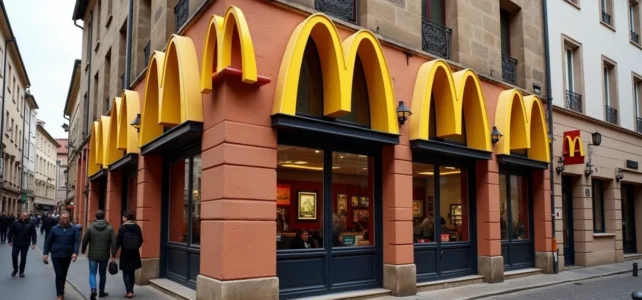
Villefranche-sur-Saône has a McDonald’s that is unlike any other. Housed in a building with stone vaults and exposed beams, it blends fast food with ancient architecture, right in the heart of Beaujolais. This coexistence between fast food and local heritage raises a rarely addressed question: how does a global brand integrate into a city that is attached to its identity without diluting it?
McDonald’s as a local facility in Villefranche-sur-Saône
Have you ever noticed that a McDonald’s, in certain cities, functions almost like a village square? Families gather there on weekends, high school students stop by after classes, and employees have lunch between meetings. This role as a meeting point goes beyond simple fast food.
In Villefranche-sur-Saône, the phenomenon takes on a particular dimension. The city, a sub-prefecture of Rhône, maintains a vibrant commercial fabric around Rue Nationale. The establishment of a fast food restaurant in this context is not by chance. Recent articles on McDonald’s expansion in France show that the brand is now positioning itself as a local service, integrated into daily life, rather than as a mere standardized counter.
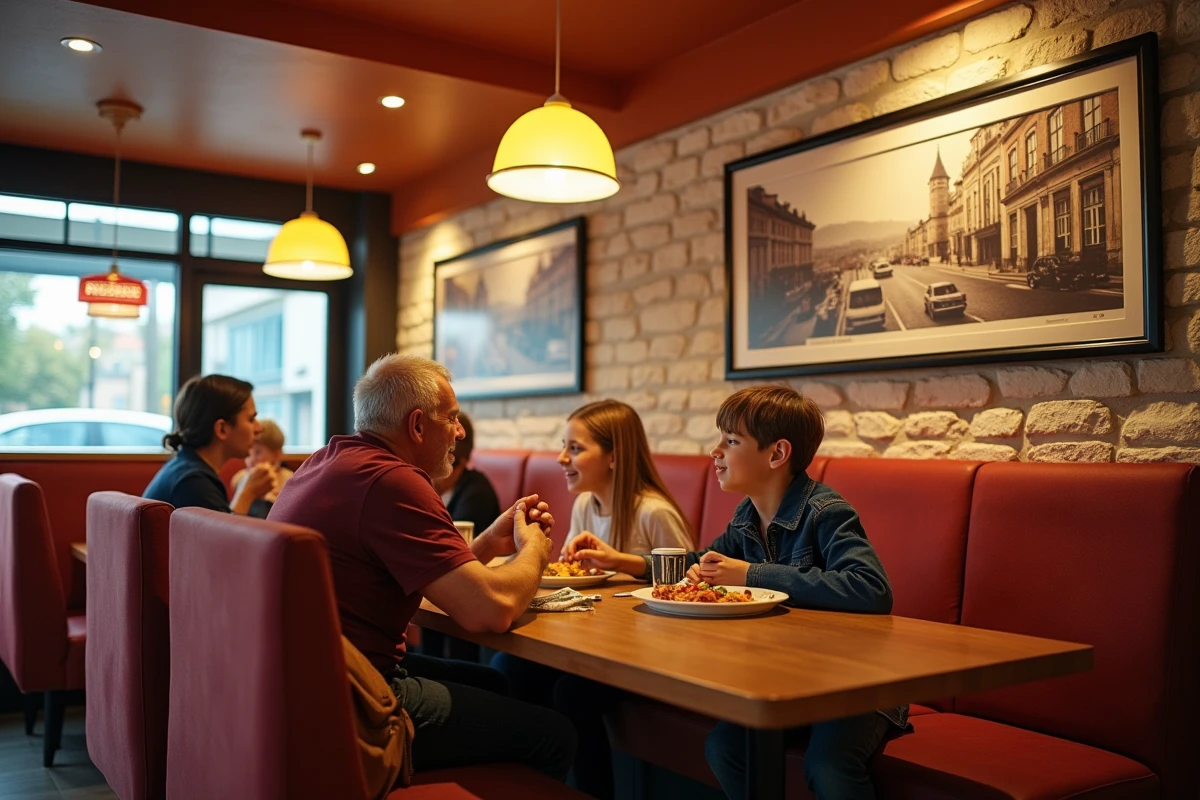
When you discover the McDonald’s in Villefranche-sur-Saône, it’s primarily the setting that surprises. The stone vaults and wooden beams create an atmosphere that contrasts with the usual decor of the chain. The historic building imposes its constraints, and the restaurant adapts to it rather than the other way around.
Historic building and fast food: the constraints of architectural coexistence
Installing a fast food brand in an old building is not just about placing a cash register and tables. The structure imposes concrete limits that are not found in a restaurant built from scratch in a commercial area.
What the old building changes on a daily basis
A vaulted ceiling cannot be pierced to run a ventilation duct. Stone walls cannot be partitioned as easily as drywall. Every modification must take into account the solidity of the structure and, often, local regulations on heritage preservation.
For the customer, these constraints translate into an atypical place. The space is less modular, the rooms are smaller, and the atmosphere is more subdued. Paradoxically, this is what makes the place memorable. People do not come just for a burger; they come for the setting.
- The original materials (stone, wood) are preserved and highlighted, giving the restaurant a unique visual identity within the McDonald’s network
- The interior layout must respect existing volumes, which limits the seating capacity compared to a standard restaurant
- The external signage is often more discreet to harmonize with the surrounding architecture, a choice that reflects the brand’s adaptation to the urban context
A replicable model or a local exception?
McDonald’s has over 1,589 restaurants in France. The majority are located on the outskirts of cities, in commercial zones. Establishments in historic city centers remain rare. Villefranche-sur-Saône is one of those cases where the restaurant becomes a marker of the urban landscape rather than just a roadside outlet.
This type of installation requires a different investment. The brand accepts higher renovation costs and a smaller footprint in exchange for a stronger local anchoring. The bet is on retaining a local clientele, not on car traffic.
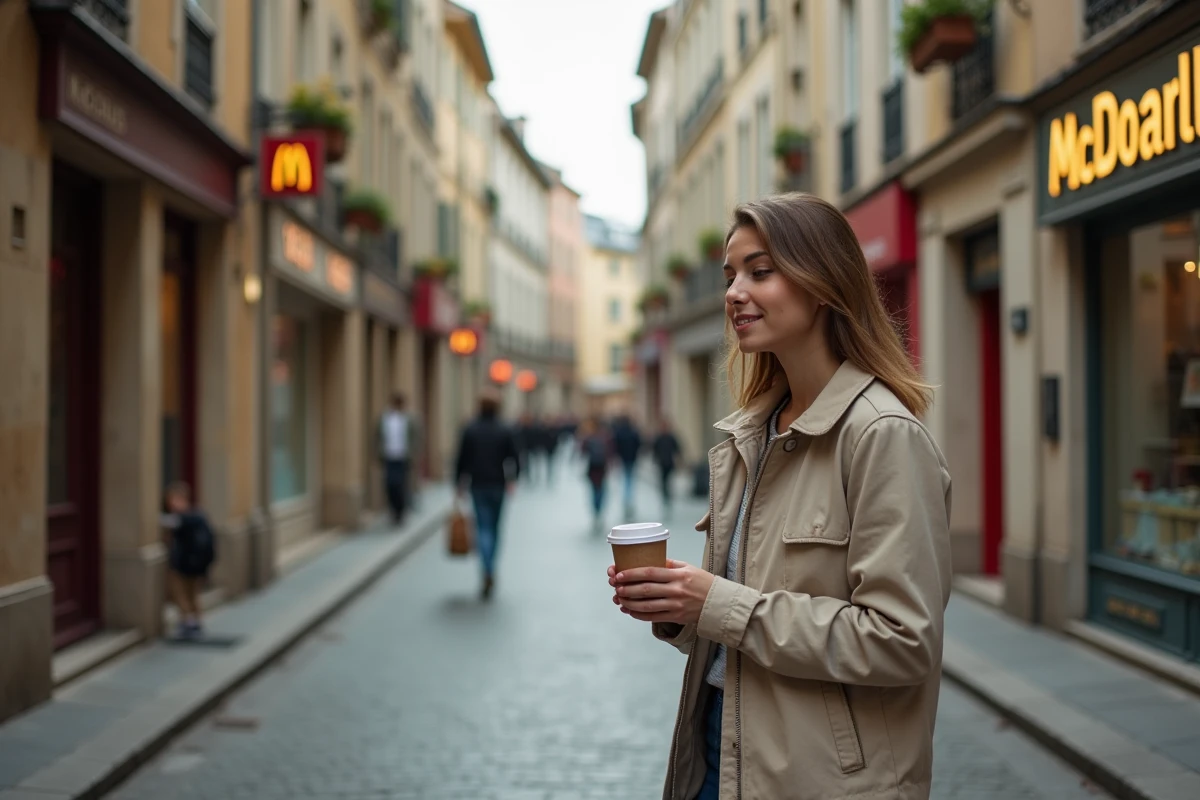
Local acceptance of McDonald’s in Villefranche: merchants, residents, and Beaujolais cuisine
Beaujolais is primarily a wine-growing region, known for its Lyonnais bouchon flavors and a well-established gastronomic pride. So how can a McDonald’s coexist with this identity without provoking rejection?
The answer partly lies in the clientele. A fast food restaurant does not replace a traditional restaurant; it meets a different need. Families who have lunch there on Saturday afternoons do not forgo Sunday pot-au-feu. Both usages coexist without directly competing.
The perspective of downtown merchants
For neighboring merchants, the presence of a McDonald’s generates foot traffic. A restaurant that attracts visitors to the city center indirectly benefits the surrounding shops. This reasoning holds as long as the brand does not cannibalize the independent restaurateurs nearby.
The nuance is here: in a city like Villefranche-sur-Saône, where Rue Nationale concentrates commercial activity, each new dining establishment alters the local balance. The elected officials who authorize this type of installation arbitrate between commercial attractiveness and the preservation of the existing fabric.
Local cuisine and fast food: two distinct registers
Why does this coexistence work better than one might imagine? Because the registers do not overlap. Beaujolais cuisine (local products, wines, Lyonnaise cuisine) caters to a different moment and budget. McDonald’s captures a demand for quick and accessible meals that traditional restaurants do not seek to satisfy.
The brand itself plays on this distinction. By establishing itself in a heritage building, it sends a signal: the fast food adapts to the place, not the other way around. This stance facilitates acceptance by residents who are attached to their living environment.
McDonald’s in the city center: what Villefranche-sur-Saône reveals about a national trend
The expansion of McDonald’s into city centers and smaller municipalities constitutes a recent strategy within the French network. The stated goal is to place a restaurant within twenty minutes of every French person, including in areas previously considered unprofitable.
Villefranche-sur-Saône illustrates an intermediate case. The city is neither a metropolis nor a rural village. It has visible architectural heritage, an active commercial life, and a sufficient population base. The establishment works there because it meets a specific local use, not just a simple calculation of traffic flow.
This model raises a question for other cities of comparable size. When a McDonald’s sets up in a historic building, it becomes difficult to dislodge. The place becomes part of habits, daily landmarks, and the mental geography of residents. The boundary between transient commerce and local facilities gradually fades, and perhaps this is what makes this coexistence between fast food and heritage as sustainable as it is unexpected.